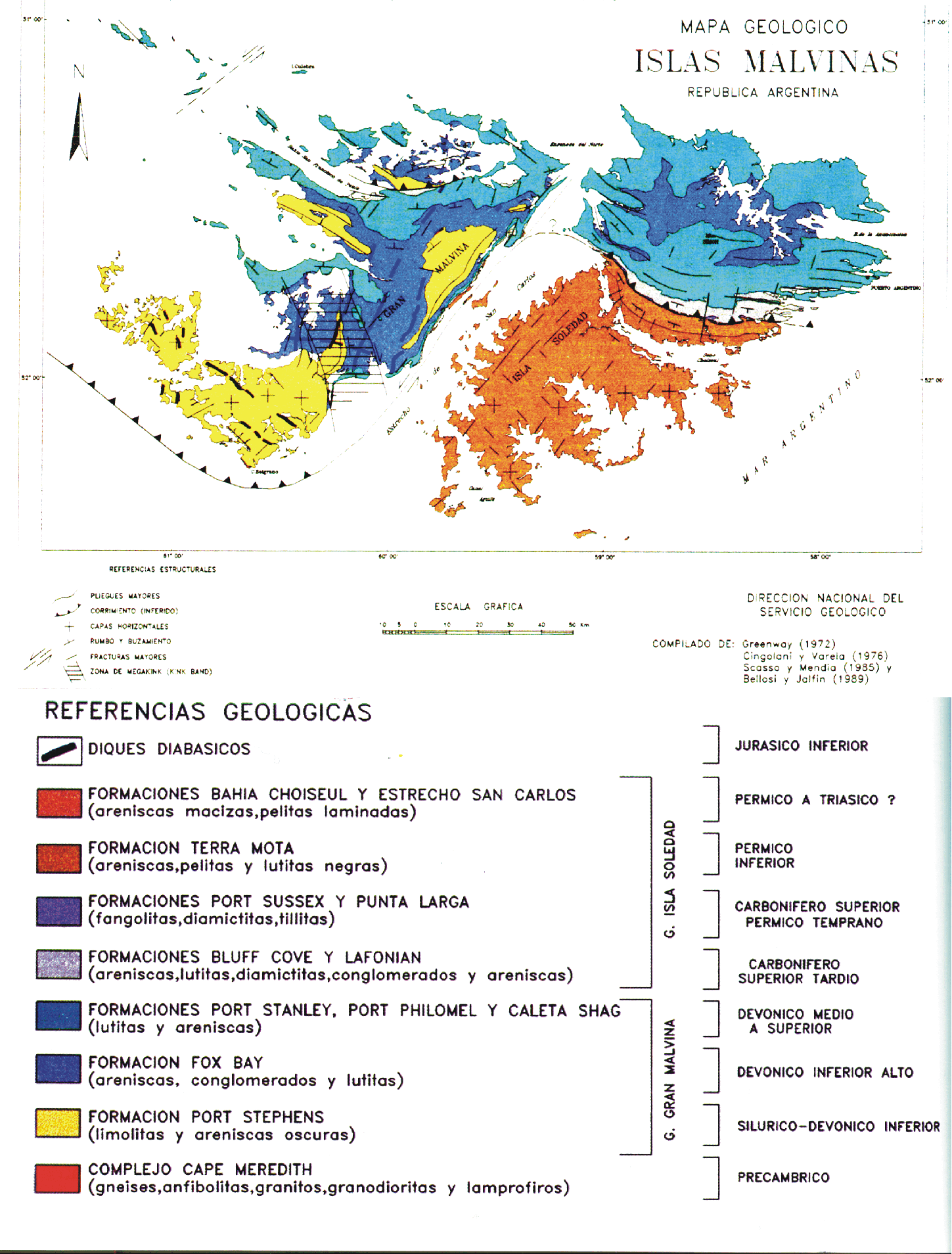

Abstract: The Falkland Islands lie on a displaced crustal block presently forming part of the South American plate. The islands possess two roughly orthogonal structural grains, the relative chronology of which is here unequivocally established for the first time. D1 structures form a southerly verging, Permo-Triassic age fold belt, striking E-W to WNW-ESE, which represents a displaced segment of the Gondwanian orogenic belt. The strike swing from E-W to WNW-ESE is coincident with a decrease in deformation intensity toward the west. On West Falkland, D1 folds are superimposed by the early Mesozoic D2, NE-SW-trending. Hornby Mountains anticline, producing localized kilometre-scale Type I and III fold interference patterns. The Hornby Mountains anticline is interpreted to be the result of dextral transpressive reactivation of a pre-existing NE-SW basement fault. If the Falkland Islands are rotated 180°, the structure of the D1 fold belt, and tectono-sedimentary features of the Permian age Lafonian Supergroup, display a remarkable correlation with the structural style and tectonic evolution of the eastern Cape Fold Belt of South Africa. Our data, therefore support a 180° tectonic rotation of the Falklad Islands and reaffirm their pre-Gondwana break-up position adjacent to the southeast coast of South Africa. In such a reconstruction the Falkland Islands constrain the easterly extension and eventual lateral termination of the Cape Fold Belt.
Abstract: Stratigraphic and sedimentological fieldwork on the Falkland Islands confirms that they were originally part of South Africa. East and West Falkland have contrasting geological and deformation histories and are separated by the Falkland Sound fault, which marks a significant deformation edge to the Cape Fold Belt. Prior to fragmentation of Gondwana the Falkland Platform and Maurice Ewing Bank were positioned in the Natal Valley, adjacent to the east coast of South Africa. This predrift reconstruction shows that the Falkland Islands have subsequently been rotated by 180° relative to South Africa and complements recent palaeomagnetic data. The Falkland Islands represent an outboard extension of the eastern Cape and are significant for understanding the paleogeography of both the Cape and Karoo supergroups.